

The city emerged on the horizon like a hallucination. After months of silence and austerity in the Empty Lands, its walls seemed too high, its noise too aggressive. This was El-Amar, a city of merchants and thieves, where every stone had a price, but not a single one possessed value.
Salim rode at the head of his diminished caravan. He wore a simple, faded cloak, yet he sat in his saddle as if an invisible army stood behind him. The people who had remained with him after the storm now looked at him differently. There was no pity in their eyes—only a deep, almost religious reverence.
In El-Amar, they were greeted not as heroes, but as prey.
“Look at these ragamuffins!” people laughed in the marketplace. “Did they come from the Empty Lands? They must have been searching for their lost brains out there!”
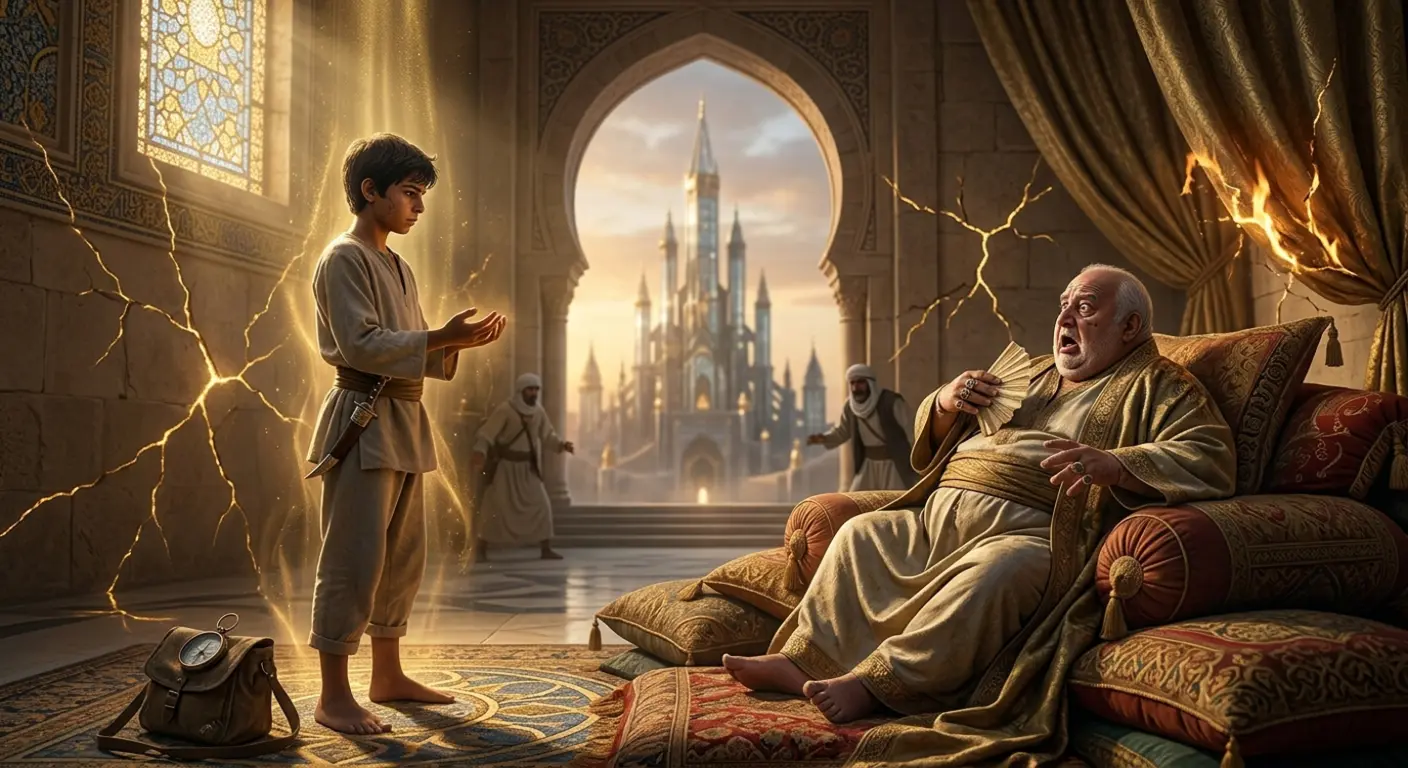
Salim needed to trade the remainder of his goods for water and fresh camels. He went to the palace of the wealthiest merchant in the city—a man named Hakim. Hakim sat upon a mountain of brocade cushions, his ringed fingers resembling fat caterpillars, while the air hung heavy with the scent of thick incense and stagnation.
“Have you brought your skeletons to me, boy?” Hakim fanned himself lazily. “I’ve heard your story. Dragons, dawns… It’s all very sweet. But here in El-Amar, we believe in scales. Your goods are worth pennies, and your people look as if it’s time to bury them. I will give you a handful of coins out of pity, and you may leave.”
Salim stood in the middle of the opulent hall, and suddenly he felt what his grandfather had warned him about. Silence. But not the peaceful silence of the desert—the dead silence of this place. He looked at Hakim and saw not a powerful rich man, but a small, frightened person who had surrounded himself with silk to avoid feeling the coldness of his own emptiness.
“You sell water you do not own, Hakim,” Salim said calmly. His voice struck through the room like a sword against a shield. “And you buy lives you cannot comprehend.”
“What did you say?!” The merchant turned crimson. “You are in my house! Guards!”
Salim didn’t flinch. He closed his eyes and for a fraction of a second envisioned that very same golden flash upon the rock. In that exact instant, the hall grew unnaturally hot. The air vibrated as if above a campfire. The heavy drapes burst into flame without fire, ignited purely by the tension in the atmosphere.
Hakim froze. He saw Salim’s shadow on the mosaic floor begin to swell, taking on the contours of something massive and winged. Golden cracks rippled across the walls, and the hum in Salim’s chest became audible to everyone present. It was the sound of crumbling mountains.
“Do you think your walls will protect you?” Salim took a step forward. “Your future smells of dust. You have hoarded gold, but you have forgotten why it is worth waking up in the morning. My caravan will leave this place with what we need. Not because you decided so. But because you cannot stop the Dawn.”
Stammering, Hakim ordered his men to give the caravan everything they required. For free. Anything to make this strange young man with the eyes of an ancient predator leave his home.
When they passed beyond the city gates, Salim felt no triumph. He felt only exhaustion.
“Why didn’t you take his gold, Salim?” one of his companions asked. “We could have lived in luxury for the rest of our days.”
Salim turned back and looked at the Glass City, which, in the rays of the setting sun, appeared beautiful yet fragile.
“Because Hakim’s gold is merely sand that he mistake for treasure. If I had taken it, I would have become part of his world. I would have become Bashir. And my journey is only just beginning.”
His grandfather had been right: the city is a far harder test than the storm. In the desert, the enemy is honest. In the city, the enemy smiles at you and offers a soft bed so that you stop looking at the stars.