


A House Within the Desert
The desert did not begin where the house ended.
It began earlier — in the breath, in the pause between steps, in the silence that required no explanation.
The house stood within it the way a thought stands in consciousness:
not as protection and not as an answer,
but as a form temporarily holding what is scattered.
Sand crept toward the walls slowly, over years, without threat and without insistence.
The wind knew the way into the courtyard and asked no permission.
At night, darkness did not fall — it simply took its place.
Here, no one said, “we live in the desert.”
They said, “we live.”
The desert was not considered an enemy.
It demanded no conquest and promised no reward.
It was a state in which a person either learned how to stand,
or disappeared, even while remaining alive.
The house did not argue with this space.
It was not a fortress.
It was an agreement.
The son grew up without distinguishing where the walls ended and the sand began.
For him, silence was as much a part of the house as the roof and the fire.
He did not fear it — he existed within it.
Some mornings the desert seemed motionless,
as if the whole world were holding its breath.
Some nights it resonated —
not with a voice, but with presence,
as if someone were standing nearby without touching.
The son knew no other places.
And therefore, he asked no questions.

The Father Who Had Seen the Limit
The father did not hurry.
Everyone who came near him noticed this.
Not because he was slow,
but because haste had once already taken him
to a place from which people do not return unchanged.
There was no fuss in his movements,
yet no sense of pursuit either.
He did what needed to be done
and stopped where stopping was more precise than taking another step.
He spoke little.
And never — unnecessarily.
When he was asked about the past,
he answered as though the past were not an event,
but a distance
that made no sense to measure.
People spoke of him in different ways.
Some thought him severe.
Some — empty.
Some — dangerous, because he needed no validation.
But the son knew otherwise.
Near his father, the world became denser.
Each thing took its place and asked for no explanation.
Words did not trail after one another —
they stopped in time.
Sometimes the son caught himself in a strange sensation:
as though his father stood not only here,
but somewhere else as well —
in a place from which he had already returned,
even though that return could not be pointed to.
There was no prohibition in his silence.
There was measure.
And the son felt that one day
he would have to learn the cost of that measure,
though for now he did not understand how.
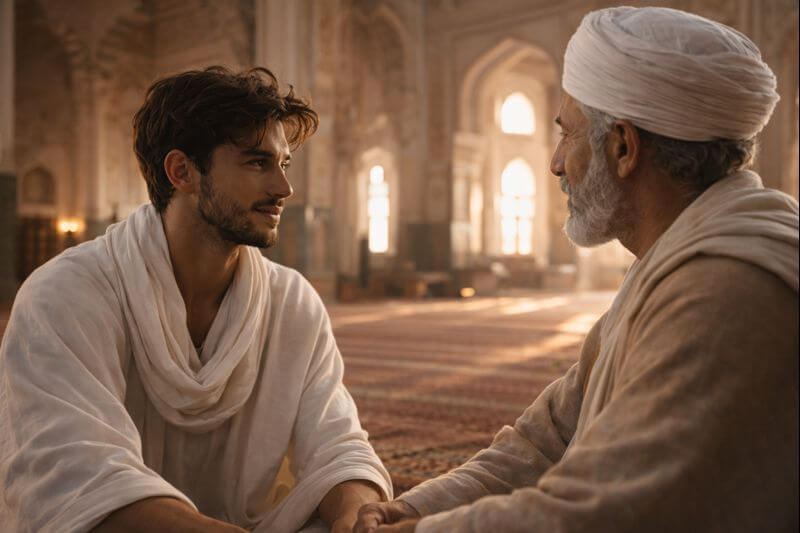
She Who Was Carried Out of the Sand
The mother was younger than the father.
This was felt not in her face,
but in the way the desert had not yet fully settled in her gaze.
There remained in her something light,
like the memory of a wind that had once been softer.
She was found after the battle.
At that time, the father was still a boy.
Not a hero and not a warrior —
simply someone who noticed life
where people usually look only at their feet.
The desert after the battle was especially quiet.
It kept no screams.
It kept traces —
broken, tangled,
quickly disappearing.
The girl sat calmly among the sand.
She did not cry.
She did not call out.
As if she were waiting not for rescue,
but for recognition of her presence.
He lifted her into his arms
without thinking how it might look.
And carried her home.
In the house, she was accepted without questions.
This is how one accepts those
whose appearance requires no decision.
She grew up beside him,
knowing no other world.
She learned to listen to silence.
She learned not to fear the night.
She learned to sense the boundary between word and meaning.
When she became a woman,
no one spoke of choice.
The desert does not know that word.
She became the wife of the one
who had once carried her out of the sand.
Not as a duty.
Not as a destiny told in advance.
But as the continuation of a path
that needed no name.
At times she looked at the father as if she knew:
he had been there,
where the desert ceases to be background
and becomes a decision.
She did not ask.
And he did not explain.
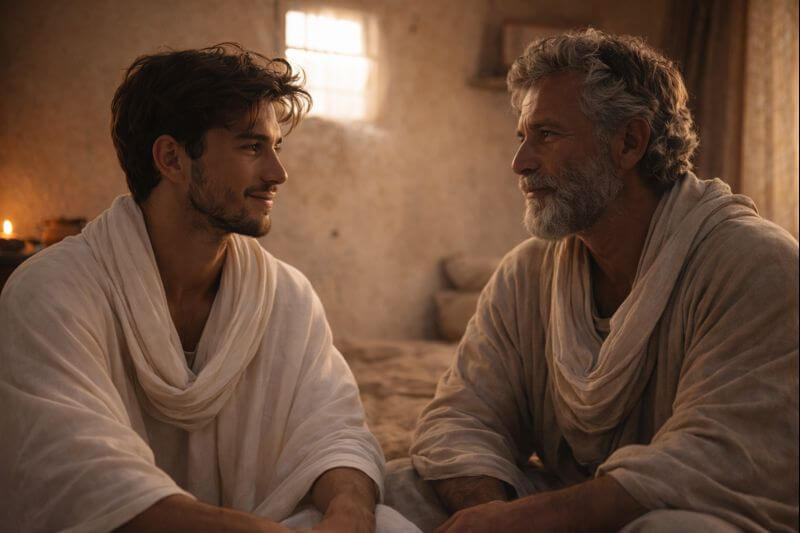
A Family Without Explanations
They lived together the way things live
that do not need to be joined by words.
The mother understood silence differently than the father.
For him, it was a boundary.
For her — a space.
She could watch the son for a long time,
without touching him or interrupting,
as if listening not to his breathing,
but to something deeper.
The son felt the difference in their ages not as a count of years,
but as a mismatch of rhythms.
The father had already passed through something
the mother had not yet forgotten.
And both lived side by side,
without explaining this to one another.
The house was full.
Hands were warm.
Nights were steady.
And yet, in this world
there was no signpost.
The son did not know where to go,
because no one said
that he had to go anywhere.
He did not feel a lack.
He felt the absence of direction.
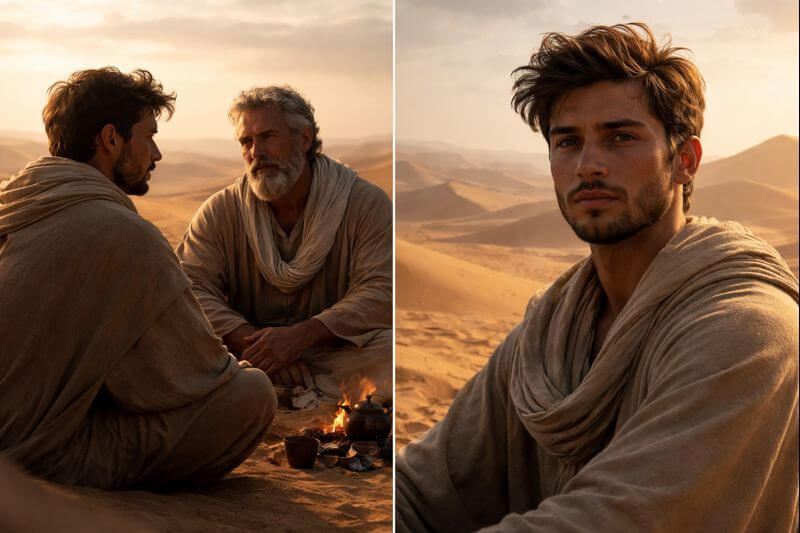
When Landmarks Stop Working
Over time, the son began to notice:
landmarks exist,
but they do not point.
Things were in their places.
Words carried meaning.
But none of them said, “this way.”
The mother paused before a word.
The father — before a thought.
And between these pauses
a space emerged
that could not be filled.
The house remained a house.
The family — a family.
The world — whole.
But direction did not appear.
The landmarks did not vanish.
They simply stopped leading.
And it was precisely here,
where it was still impossible to leave,
yet already impossible to remain the same,
that the desert of thought began.