


Part I — The Desert of Thought The First Desert: The House
Waiting for the Word
For a long time, the son did not understand what exactly he was waiting for.
It seemed to him that one day his father would simply say —
not loudly, not ceremoniously,
but the way one speaks of something self-evident:
“this is how.”
Not a path —
a direction.
Not an answer —
a support.
He did not put this into words.
He simply lived with the sense
that beside him stood someone
who knew
where one should not go
and where it was better to stop.
At times the son caught his father’s gaze,
and there was too much silence in it —
a silence
in which questions could not fit.
He waited for the moment.
The right age.
The right day.
The right pause.
He thought:
it is too early.
I have not asked correctly.
I have not yet earned it.
Waiting became habitual,
like waiting for wind in the heat:
you do not call for it,
but you know — it happens.
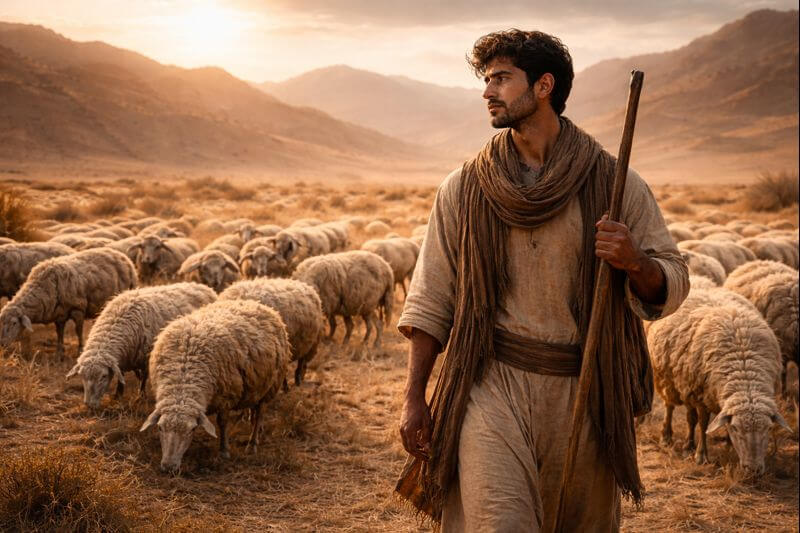
A Conversation That Does Not Begin
One day, the son finally spoke.
Not directly.
Not with a question.
He began from afar —
from what he saw,
from what he felt,
from what did not come together.
He spoke cautiously,
leaving space for an answer,
as if his father’s words could fill the pauses on their own.
The father listened.
He did not interrupt.
He did not prompt.
He listened as though every word of the son
had to reach its end,
even if it carried no meaning.
When the father answered,
the answer did not meet expectation.
He did not say, “you are right.”
And he did not say, “you are wrong.”
He said something else.
Simple.
Inexact.
As if it were not about that at all.
The son felt irritation.
Not from the words —
from their disproportionality.
The conversation did not break off.
It simply did not begin.

A Memory That Cannot Be Passed On
At times, the father spoke of the past.
Not by telling.
Not by returning.
But as if touching it only at the edge.
A phrase.
A gesture.
A gaze that lingered longer than necessary.
The son understood:
there was something there
that could not be transmitted whole.
Not because it was forbidden,
but because it would not fit into form.
The father did not conceal anything.
He simply did not translate what he had lived through
into a language
the son could use.
And this was heavier
than silence.
The son felt that
if the father had lied,
if he had simplified,
if he had offered a convenient answer —
it would have been easier.
But the father did not do this.
He left the past
where it had been lived.
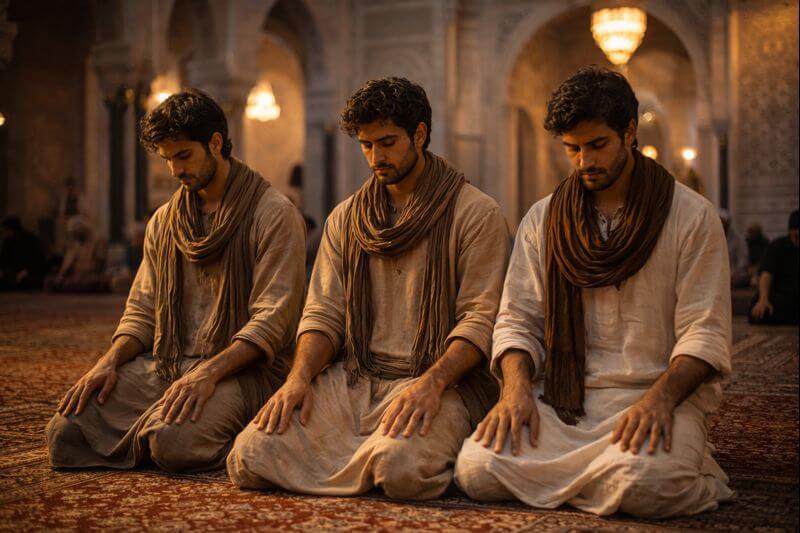
Irritation Born of Silence
Over time, waiting became burdensome.
The son began to grow angry.
Not aloud.
Not directly at his father.
He was angry at the absence of form —
at the fact that everything around him existed,
yet did not arrange itself into a line.
He wanted measure.
Even if only temporary.
Even if mistaken.
He felt that silence no longer calmed him.
It began to press.
The father’s words,
which once seemed profound,
now irritated him.
They did not help him move.
The son caught himself thinking
that he wanted to leave —
not because he knew where to go,
but because staying had become unbearable.
But he did not leave yet.
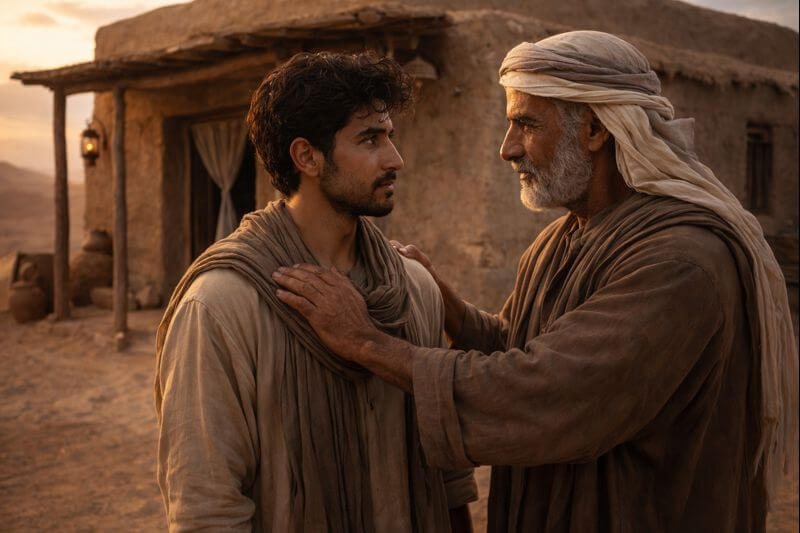
When One Cannot Walk Together
One day, the son understood
what his father had never spoken aloud.
The father did not point the way
not because he did not know it.
And not because he wished to test him.
But because this path
cannot be walked side by side.
There are places
where another’s step
prevents you from hearing your own.
There are distances
at which presence
becomes an obstacle.
The son understood this
not as knowledge,
but as weight.
He still did not know
where he would go.
He was not yet ready to walk.
But he understood this:
to remain in waiting
is to lose movement
before it has even begun.
The father was silent for a long time.
Then he said, without raising his voice:
— Yusuf. You have carried your name for a long time.
But a name is not something that is given.
It is something that must be endured.
He did not explain.
He did not clarify.
The father remained nearby.
Physically.
Truly.
But the path
that had begun to form within Yusuf
no longer allowed accompaniment.
And the silence between them
became different.
Not empty.
But preparatory.